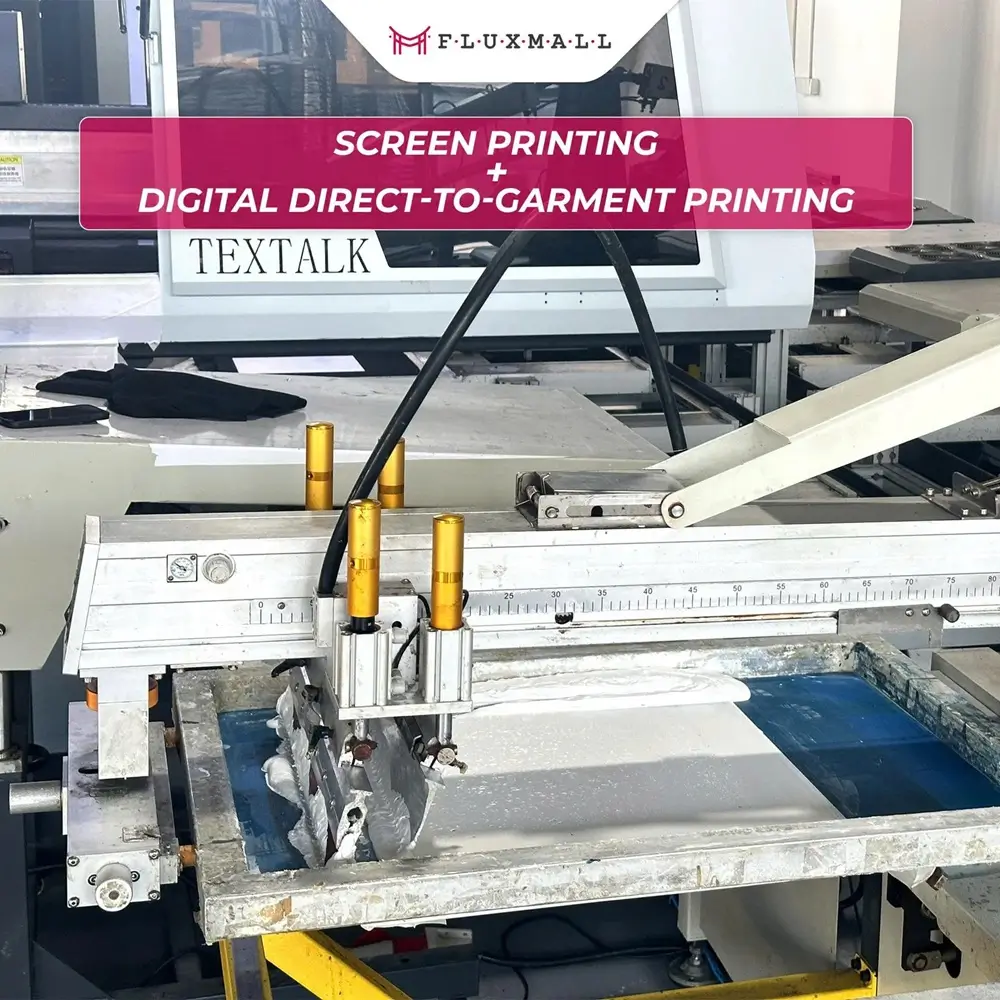
Screen print underbase + DTG color is a hybrid method where you lay down a screen-printed white base first, then DTG prints the full-color artwork on top. Technical teams use it for one main reason: it keeps screen printing’s speed and opacity while letting DTG handle gradients, fine detail, and rapid artwork changes without building a complex screen set.
This approach is especially attractive when you want more “pop” on dark garments. Or you’re trying to cut setup time, reduce screens, and stabilize production output.
White underbase screen print: Why use a screen base instead of DTG white?
A screen underbase is the fastest way to create an opaque foundation on dark garments. Compared to printing white entirely with DTG, a screen base can be:
- More consistent at scale: one well-controlled base beats chasing white behavior across many DTG jobs.
- More efficient for coverage: the screen can lay down opacity quickly.
- Cleaner for detail: DTG can focus on color and fine features instead of building a heavy white layer.
For this method to work well, the underbase must be engineered for overprint. The goal is an even, smooth, and not overly thick surface because DTG color needs a stable surface.
If you want to tighten underbase control, such as opacity vs. detail, smoothness, and edge behavior, Fluxmall’s “White Underbase Control Tutorial” is a useful technical reference.
DTG overprint: How the process works on a production line
DTG overprint is straightforward in concept, but it only stays stable when you control surface condition and timing.
A typical production sequence looks like this:
- Screen print the white base with consistent coverage (same squeegee pressure, angle, mesh, and ink deposit each run).
- Flash/gel the base enough to stabilize it for handling, without over-curing it into a slick surface that resists DTG ink.
- DTG prints CMYK color on top with profiles designed for “printed base” behavior (not the same as printing directly into raw cotton).
- Final cure according to the ink system requirements so both layers survive wash and wear.
Two technical notes that prevent most failures:
- Registration discipline matters more than usual. Any platen shift or garment skew shows immediately when you’re stacking processes.
- Surface finish matters. If the base is too textured, DTG color can break up; if it’s too glossy, adhesion can suffer.
For shops planning a true hybrid upgrade (screen + DTG integrated into a production model), Fluxmall’s overview of Textalk hybrid systems explains the positioning and where the workflow fits in mass production.
Brighter colors: Why overprinting on a screen base increases “pop”
This method often produces brighter colors on dark shirts because the DTG color is printed onto a controlled, opaque base rather than fighting the fabric’s darkness.
In practice, the color boost comes from:
- More stable reflectance (the underbase acts like a consistent “canvas” across garments)
- Less reliance on heavy DTG white (DTG can prioritize color detail instead of ink mass)
- Cleaner gradients and highlights (digital handles subtle transitions that would otherwise require extra screens)
If your team is chasing “vibrancy” and also trying to keep hand feel under control, this approach can be a strong middle path. The screen will provide the base, and DTG provides the finesse.
Reduce screens: How hybrid underbase simplifies screen printing
The biggest operational win is how it helps you reduce screens on complex artwork.
A common scenario:
- A design that would require multiple color separations, especially if it contains gradients, textures, or photographic elements.
- Instead, it becomes one reliable white underbase screen combined with DTG full color.
That reduces:
- Screen making and reclaim load.
- Registration steps and setup time.
- The number of variables that can drift during long runs.
It’s also a practical way to protect your press schedule: the screen stays productive at what it’s best at, while DTG absorbs complexity without slowing your line with extra screens.
Wash durability: Quality and curing rules that protect the final screen print
Hybrid prints can be very durable, but only when you treat curing and compatibility as part of the process, not an afterthought.
What protects wash durability most consistently:
- A stable underbase cure state: flashed enough to hold shape, not so “sealed” that DTG struggles to bond.
- A controlled final cure: consistent temperature/time/pressure for your ink stack.
- A repeatable QC routine: a quick stretch check for cracking and periodic wash testing for each garment/ink combination.
If you’re seeing edge cracking, dulling after washing, or color flaking, don’t jump straight to RIP tweaks. In many cases, the root cause is one of these:
- Underbase deposit too heavy. This will create a brittle stack.
- Flash/cure mismatch, either under- or over-flashed base.
- Inconsistent garment moisture/pretreat conditions. Yes, even with a screen base, surface prep still matters.
For tightening upstream consistency (especially on dark garments), Fluxmall’s DTG pretreatment best-practices guide can help operators stabilize the variables that still affect adhesion and detail.
Hybrid printing system: When this method is optimal vs pure screen or pure DTG
A hybrid printing system approach using a screen underbase and DTG color is usually optimal when you have volume plus complexity.
Here’s a clean way to decide:
| Your reality | Best fit | Why |
|---|---|---|
| Large repeats, simple spot colors. | Pure screen. | Lowest unit cost and fastest throughput. |
| Short runs, high SKU variety, and fast changes. | Pure DTG. | Minimal setup, file-to-print efficiency. |
| Medium-to-high volume with complex artwork on dark garments. | Screen underbase + DTG color. | Bright results, fewer screens, and DTG handles detail reliably. |
If you’re considering this as a formal production upgrade (not a one-off technique), the best next step is to evaluate an integrated workflow in a demo environment, especially for registration, curing, and repeatability across a run. Textalk demo scheduling is available through Fluxmall here. Or you can learn more about the Textalk Hybrid printer range through this highlights guide.