Choosing hybrid printing vs screen printing vs DTG is less about “best technology” and more about matching the process to your factory reality: run sizes, daily SKU mix, delivery speed, and how often artwork changes.
The screen printing method is still the volume king when designs repeat. DTG is the fastest path for variability and short runs. Hybrid sits in the middle. It keeps screen productivity while adding digital capability where screens become slow or expensive.
If you’re comparing real production directions (not just theory), the Textalk hybrid positioning for mass production is a helpful reference for how factories combine screen and DTG in one workflow.
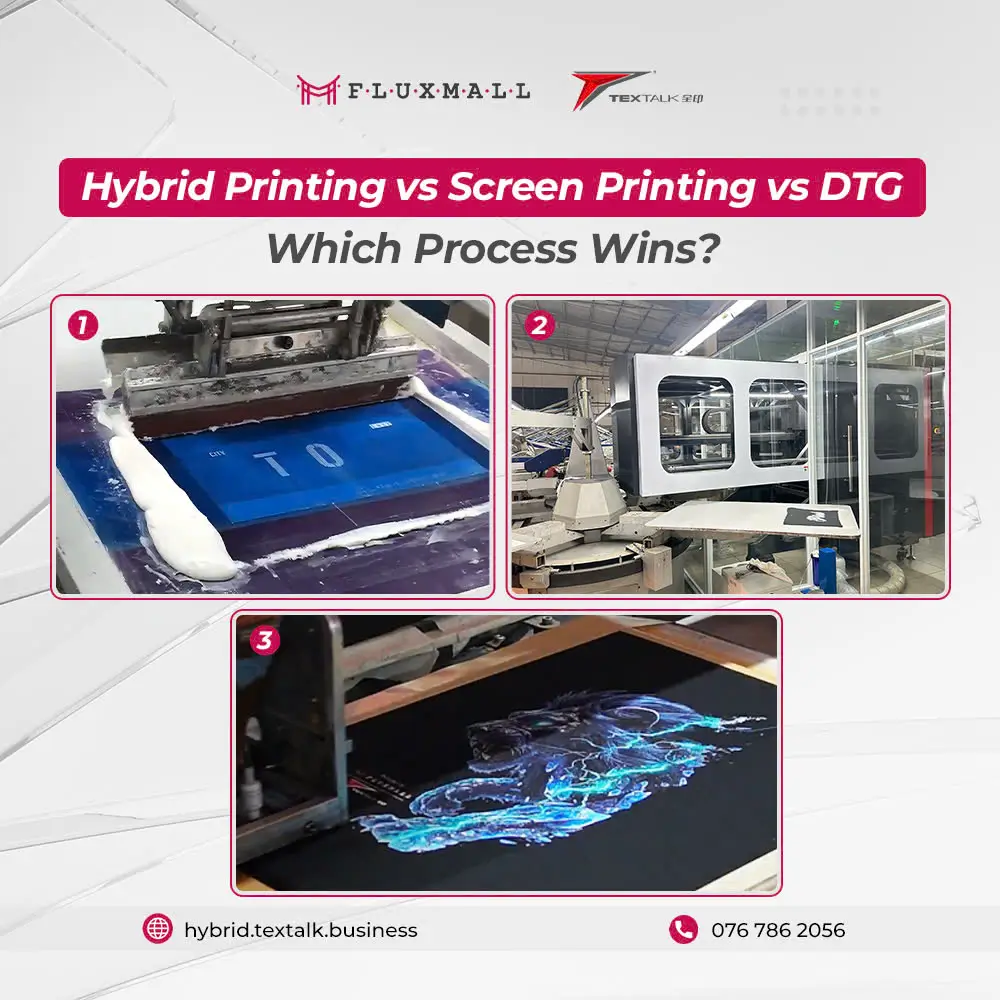
Setup time: What do you pay before the first sellable print?
Setup time is where processes diverge most.
Screen printing has the highest setup overhead because you’re building a physical production state: screens, registration, ink mixing, and cleanup. Once it starts, the line runs fast, so setup cost gets “amortized” over long runs.
DTG has the lowest setup time. For most jobs, it’s file-to-print: load garment, print, and cure. That’s why DTG is so effective when orders are small, frequent, or unpredictable.
Hybrid reduces setup time when the design complexity would normally require many screens. A common hybrid logic is to keep the screen for what it’s best at (bases/solids/repeats). On the other hand, let digital handle the parts that would add screens, registrations, and press stoppages.
If your team is planning an upgrade path from screen-only to hybrid, it helps to view hybrid as a workflow choice, not a printer add-on. This overview of how hybrid DTG helps scale apparel printing with Textalk frames that have a “line first” mindset.
Cost per print: Hybrid Printing vs Screen Printing vs DTG
Cost per print is not a single number. It changes with run length, SKU variety, and reprint rate. Let us compare screen printing vs DTG vs hybrid now!
Screen printing usually has the lowest cost per print after accounting for setup costs. That’s why it dominates long runs of the same design. The hidden cost shows up when the job mix is messy: frequent changeovers, many SKUs, or complex art that requires multiple screens.
DTG cost per print is typically more stable across runs because setup is minimal. On large repeats, however, the cost per unit may remain higher than the screen because you are paying for consumables, maintenance, and time when printing each unit digitally.
Hybrid cost per print often wins when you’re producing volume with complexity, especially on dark garments or designs that would require many screens. The savings come from reducing screens, shortening setups, and keeping the press productive while digital handles detail.
A practical factory way to compare cost per print is to include rework as a cost line. The method that produces the most “first-pass good” units per shift often wins even if consumables are higher.
Short runs vs long runs: A decision map for factories
Most factories don’t need one method. What they need is a routing rule.
Here’s a production-friendly guide for short runs vs long runs (assume comparable garment type and finishing capacity). This table also shows the comparison of three methods: Hybrid Printing vs Screen Printing vs DTG.
| Production scenario | Screen printing | DTG | Hybrid |
|---|---|---|---|
| Short runs, many SKUs, frequent changes. | Weak (setup dominates). | Strong (file-to-print). | Strong if digital is integrated and stable. |
| Medium runs with complex art on dark garments. | Can be costly (many screens). | Can be slower or heavier on white. | Often strongest (screen base + digital detail). |
| Long runs, repeat designs. | Strongest (lowest unit cost). | Often not ideal. | Strong when complexity/personalization is mixed into volume. |
| Personalization inside bulk orders. | Inefficient. | Strong. | Strong (screen for base volume, digital for variants). |
If your factory is evaluating “industrial DTG” alongside hybrid options, it’s useful to browse what production-class DTG looks like in one place (systems intended for higher volume and uptime planning).
Flexibility: How each method handles SKU chaos and personalization
Flexibility is where hybrid and DTG typically perform better than pure screen printing.
DTG works best when the business model is one of variability, such as micro-drops, quick reorders, frequent artwork changes, and personalized names. It’s also the easiest to route when your order mix changes daily.
Screen printing is flexible in skilled hands, but the process cost rises with complexity: more screens, more setup time, and more stoppages. Screen printing stays unbeatable when the same artwork repeats and planning is predictable.
Hybrid flexibility comes from routing. You can keep the press doing what it’s best at while digital absorbs the “SKU chaos” that would normally disrupt screen productivity. That’s why hybrid is popular for factories serving brands that want both speed and variety.
If you want to see how Textalk systems perform across hybrid and production contexts, this Textalk collection is a useful starting point.
Best for mass production: Which method is the best?
“Best for mass production” depends on whether mass production consists of producing multiple designs at once or just one design.
When repeats predominate in output, screen printing works best for mass production. It gives the lowest unit cost and the fastest sustained throughput once the press is set.
DTG can support mass production when the workflow is engineered like a line. The workflow includes balanced curing, disciplined job control, and maintenance planned as uptime protection. Many factories underestimate that requirement, then blame the printer when the real bottleneck is finishing.
Hybrid is best for mass production when you’re combining volume with complexity. It protects screen throughput while reducing screen count and changeover pressure, especially for graphics that are hard to screen efficiently.
For factories considering an integrated POD-style line (pretreatment + white + color as a production sequence), the Textalk POD Solution is outlined.
Hybrid printing vs screen printing vs DTG: A simple evaluation checklist for production buyers
When you evaluate hybrid printing vs screen printing vs DTG, don’t start with technology. Start with constraints:
- What percentage of your volume consists of variable SKUs versus repeat designs?
- How often do you change artwork per day?
- What is your dark garment ratio (and how sensitive is your workflow to white/pretreat/curing)?
- What is your actual KPI: finished, QC-passed units/shift or prints/hour?
- How much operator dependence and downtime can you tolerate?
If you’re ready to compare process options with real samples and production questions (throughput, routing rules, curing capacity, labor plan), contact us and book a Textalk demo through Fluxmall here.